
Thank you!
Thank you for submitting the form. The Kalpataru team will get in touch with you.
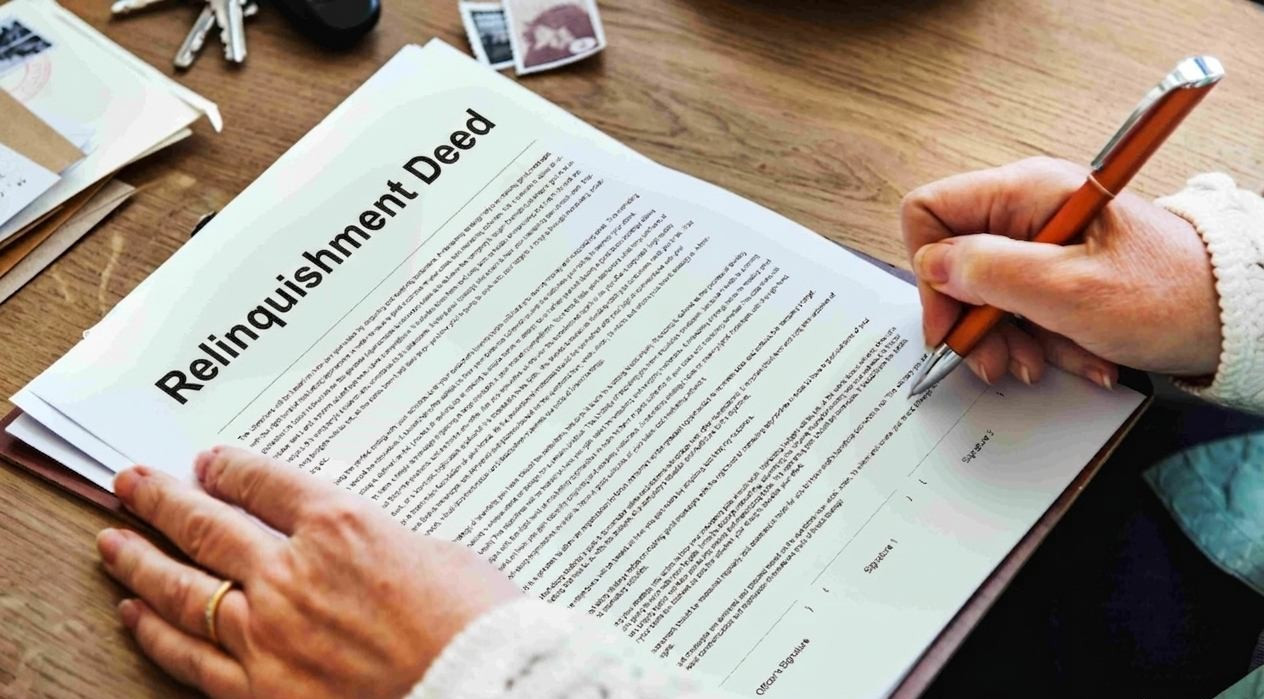
Relinquishment Deed: Meaning, Process and Charges in India
Picture three siblings in the queue at a sub-registrar's office in Thane, holding a deed that transfers their late father's flat to the eldest brother. Two have signed. The third, a sister who lives in Dubai, has not. Everyone assumes her share will sort itself out later.
It will not. That one missing signature is the difference between a clean title today and a property no careful buyer will touch ten years from now.
A relinquishment deed is the document built to solve exactly this problem. It is also one of the cheapest instruments in Indian property law, but only when three specific conditions hold. Miss any one of them, and the same sheet of paper is taxed like a sale.
What Is a Relinquishment Deed?
A relinquishment deed is a written, registered document by which one co-owner of a property gives up their share in favour of another co-owner or legal heir. The person giving up the share is called the releasor. The person receiving it is the releasee.
The relinquishment deed meaning comes down to subtraction rather than sale. You step out of the ownership, and the shares of the remaining owners grow to fill the gap. Nobody buys anything.
This is why families reach for it after an inheritance. When a parent dies without a will, the flat or the land passes to all the legal heirs jointly, whether or not they want it. A relinquishment deed for property lets the heirs who do not want a stake hand it to the one who does.
When a Relinquishment Deed Is Used, and When It Is Not
Families put this off because it feels like a formality between people who already agree. It is the opposite, and it has a narrow shape.
Three conditions define when a relinquishment deed applies:
- The property must already be held jointly, by two or more people. A sole owner has nothing to relinquish.
- The transfer must run from one existing co-owner to another co-owner or legal heir. A release in favour of someone outside that group is not a relinquishment at all; the law treats it as a gift.
- The relinquishment must be voluntary and free from coercion, fraud or undue influence. A deed signed under pressure, deception or undue influence can be set aside by a court.
So the sister in Dubai can release her share to her brothers. She cannot use a relinquishment deed to hand it to her husband, who was never a co-owner. That transfer would need a gift deed.
Be clear about what the deed does not do. It does not physically divide a property, and it does not settle who repays an outstanding home loan unless it says so. Society records and the municipal tax register are separate updates.
Relinquishment Deed vs Gift Deed vs Sale Deed
Families often use these three words as though they were interchangeable. They are not, and choosing the wrong one is expensive.
| Parameter | Relinquishment Deed | Gift Deed | Sale Deed |
|---|---|---|---|
| Who can receive | Only an existing co-owner or legal heir | Anyone the owner chooses | Any buyer |
| Money involved | Usually none | None | Yes, the agreed price |
| What moves | Your share in a jointly held property | Full ownership of the property or share | Full ownership |
| Typical use | Consolidating an inherited flat in one heir's name | Passing property to a child or spouse | An arm's length purchase |
| Income tax on the receiver | Exempt when the parties are defined relatives | Exempt when the parties are defined relatives | Not applicable |
The tax line deserves a second look. Under Section 56(2)(x) of the Income-tax Act, property received without payment from a defined relative is exempt in the recipient's hands. Outside that circle, the recipient can be taxed on the stamp value of what they receive.
Relinquishment Deed Charges: What Decides ₹200 or Lakhs
Most articles quote a single national figure for relinquishment deed charges. There is no such figure. Stamp duty is a state subject, and in Maharashtra the rule turns on three conditions rather than one rate.
Under Article 52 of Schedule I to the Maharashtra Stamp Act, 1958, a release attracts a flat ₹200 in stamp duty when all three of these hold:
- The property is ancestral, not self-acquired.
- No consideration passes, meaning no money or value changes hands for the release.
- The deed is executed by or in favour of a specified relative: a spouse, brother, sister, son, daughter, father, mother, the son or daughter of a predeceased son, or the legal heirs of those relations.
Break any one of those, and Article 52 charges the deed at the conveyance rate, the same rate a sale attracts.
The Rule Most People Miss
Here is the part that changes the arithmetic. Even when conveyance duty does apply, it is charged only on the market value of the share being released, not on the value of the whole property.
Take four siblings who each hold a quarter of an inherited flat, and one releases her quarter. Duty is calculated on that quarter alone. That is why a relinquishment deed is usually cheaper than any other route, even when it misses the ₹200 rate.
Registration Fees, and a Word of Caution
The registration fee in Maharashtra is generally 1% of the value, capped at ₹30,000. Sources differ on how a family release valued at a nominal amount is treated in practice, so confirm the figure with your sub-registrar's office before budgeting.
Where the classification is unclear, and whether a property counts as ancestral is the usual sticking point, seek an adjudication ruling from the Collector of Stamps before registration rather than face a demand afterwards.
How to Register a Relinquishment Deed: Six Steps
Section 17(1)(b) of the Registration Act, 1908 makes registration compulsory for any document that creates or extinguishes a right in immovable property worth ₹100 or more. That covers every relinquishment deed you are likely to sign.
Step 1: Confirm Who All the Co-Owners Are
Pull the title documents, the succession or legal heir certificate, and the society records. Every person with a share must be accounted for, including heirs living abroad.
Step 2: Get the Deed Drafted by a Property Lawyer
The wording has to identify the property, the parties, the exact share released and the fact that the release is voluntary. Loose drafting is the most common reason a deed is questioned years later.
Step 3: Calculate and Pay the Stamp Duty
Work out which limb of Article 52 applies before buying the stamp paper. If there is doubt, this is the point to seek adjudication.
Step 4: Sign Before Two Witnesses
The releasor signs, and two witnesses attest the signature. Both witnesses need their own identity proof.
Step 5: Register at the Sub-Registrar's Office
All parties and both witnesses attend with identity proof, address proof and passport-sized photographs, in original and copy. The sub-registrar verifies everything and records the deed.
Step 6: Update the Downstream Records
Apply for transfer of the share certificate in the co-operative housing society, update the property tax record, and tell the bank if a loan is running.
Why Step 5 is not optional: under Section 49 of the same Act, a document that should have been registered but was not does not affect the property at all, and it cannot be received in court as evidence of the transaction. In K.B. Saha and Sons Pvt. Ltd. v. Development Consultant Ltd., (2008) 8 SCC 564, the Supreme Court held that where a document is inadmissible for want of registration, none of its terms can be admitted in evidence. An unregistered release is a piece of paper.
Deed of Relinquishment Format: What the Document Must Contain
You will find downloadable templates online. Use them to understand the shape of the document, not to fill in and sign. Precision in the drafting is what makes a deed hold.
A sound deed of relinquishment format covers:
- The date and place of execution.
- Full particulars of the releasor and releasee: name, age, address and their relationship.
- How the property came to be jointly held, naming the deceased owner and the mode of inheritance.
- A complete description of the property, with survey or CTS number, area and boundaries.
- The exact share being released, stated as a fraction, with a clear statement that the release is voluntary and without consideration.
- The list of all legal heirs, so that nobody is left unaccounted for.
- Signatures of the releasor, the releasee and two witnesses, with their details.
If the release is made for payment, say so plainly in the deed. Concealing a payment to hold on to the ₹200 rate is exactly the shortcut that unravels under scrutiny later.
Before You Sign: Five Checks That Protect the Title
1. Account for Every Daughter's Share
In Vineeta Sharma v. Rakesh Sharma, (2020) 9 SCC 1, decided on 11 August 2020, the Supreme Court held that a daughter becomes a coparcener in a Hindu joint family by birth, in the same way a son does. The right is exercisable from 9 September 2005, and the father need not have been alive on that date.
The practical consequence is blunt. Family settlements done in the 1990s and early 2000s frequently left daughters out. If the title chain of the flat you are buying has a daughter whose share was never released, that is a live claim, and a buyer's lawyer will find it.
2. Check the Tax Position Before, Not After
Section 2(47) of the Income-tax Act includes relinquishment of an asset within the definition of a transfer. If the releasor receives payment, that can be assessed as capital gains, as the Income Tax Appellate Tribunal has held. Under Section 49(1), the receiver also inherits the original owner's cost of acquisition, which matters when the property is eventually sold.
3. If You Are an NRI, Plan the Paperwork Early
An heir abroad who cannot travel acts through a Power of Attorney, a document authorising someone in India to act on their behalf. Sign it before a notary, then obtain an apostille in Hague Convention countries, or attestation from the Indian Embassy or Consulate in countries outside it, including the UAE. The original travels to India for stamping and, for immovable property matters, registration. Sub-registrars are often more comfortable with consular attestation than with an apostille, so many families obtain both.
4. Accept That You Cannot Simply Change Your Mind
A registered relinquishment deed cannot be cancelled unilaterally. It can be undone by mutual consent through a registered cancellation deed, or set aside by a court where fraud, coercion or undue influence is proved. A challenge is generally expected within three years of execution under the Limitation Act, 1963. Confirm the position for your facts with a lawyer.
5. Look at the Whole Chain, Not Just Your Share
Title clarity is cumulative, which is why many buyers prefer a first-purchase home in a developed project, where ownership begins with the developer rather than three generations of a family. Kalpataru Parkcity in Thane, a 100+ acre township on Kolshet Road offering 2, 3 and 4 Bed residences, is one example of that clean starting point.
For specific legal and financial advice regarding property transactions, we recommend consulting with qualified professionals such as lawyers, chartered accountants, or financial advisors.
A relinquishment deed is a small document with long consequences. It works when everyone holding a claim signs it and when it is registered rather than filed away in a cupboard. Before you sign, check three things: whether the property is ancestral, whether any money is changing hands, and whether every heir with a share is named on the document. Get those right, and a tangled family property becomes a clean, saleable asset.
With more than 56 years of building trust, 130+ completed projects and over 26,500 happy families, Kalpataru has seen how much easier ownership becomes when the paperwork is sound from the start. Explore Kalpataru's residential projects across Mumbai, Thane and Pune, or speak with our property consultants about what a clear title should look like.
Frequently Asked Questions
1. What Is Relinquishment Deed in Property Law?
It is a registered document by which one co-owner gives up their share to another co-owner or legal heir. Families use it when several heirs inherit a flat jointly and want ownership in one name.
2. What Are the Relinquishment Deed Charges in Maharashtra?
Under Article 52 of the Maharashtra Stamp Act, 1958, stamp duty is a flat ₹200 when the property is ancestral, no money changes hands, and both parties are specified relatives. Otherwise it is charged at the conveyance rate, on the share released alone.
3. Can a Relinquishment Deed Be Revoked?
Not unilaterally. Once registered, it can be undone only by mutual consent through a registered cancellation deed, or by a court order where fraud or coercion is proved.
4. What Is the Difference Between a Relinquishment Deed and a Gift Deed?
A relinquishment deed works only between existing co-owners or heirs and normally involves no payment. A gift deed can pass property to anyone. Release your share outside the co-ownership and the law reads it as a gift.
5. Is Registration of a Relinquishment Deed Compulsory?
Yes. Section 17(1)(b) of the Registration Act, 1908 covers any document extinguishing a right in immovable property worth ₹100 or more. An unregistered deed does not affect the property and is inadmissible in court.
6. What Documents Are Required to Register a Deed of Relinquishment?
The original title documents, proof of joint holding, the succession or legal heir certificate, PAN and Aadhaar for every party, passport-sized photographs, and identity proof for both witnesses.
7. Can an NRI Execute a Relinquishment Deed from Abroad?
Usually yes, through a Power of Attorney given to someone in India. It is signed before a notary, then apostilled or attested by the Indian Consulate, and sent to India for stamping and registration.
8. Does a Daughter Need to Sign the Relinquishment Deed?
If she has a share, yes. Following Vineeta Sharma v. Rakesh Sharma (2020), a daughter is a coparcener by birth with the same rights as a son. A chain missing her release carries a real risk of challenge.