

Thank you!
Thank you for submitting the form. The Kalpataru team will get in touch with you.
Commercial Real Estate Trends in India 2026
In the second quarter of 2026, India’s office market did something it had never done before. Gross leasing touched roughly 24.6 million square feet in a single quarter, an all-time high, with developers matching that appetite through around 21 million square feet of fresh completions. That’s not a market limping along. That’s a market running.
If you’re an investor weighing your next move, or a business owner deciding whether to buy or lease your next workspace, these commercial real estate trends matter to you directly. The numbers below aren’t just headlines for analysts. They shape what you pay, where you look, and how you get in. Let’s walk through what 2026 is really telling you, and what to do about it.
What the 2026 Commercial Real Estate Trends Are Really Telling You
Before the individual trends, it helps to see the scale, because the commercial real estate trends of 2026 all rest on one foundation: sustained demand. India’s office leasing for 2026 is projected to stabilise at 70 to 75 million square feet, with net absorption (the space actually occupied after accounting for vacancies) expected near 55 million square feet. The first quarter alone saw 21.9 million square feet leased across the top eight cities, a 13% jump year-on-year, with Mumbai (30%), Bengaluru (23%), and Hyderabad (14%) doing much of the heavy lifting.
Here’s the part investors notice most. Capital inflows into Indian real estate reached about ₹42,000 crore (5.1 billion US dollars) in the first quarter of 2026, up 72% year-on-year. When large investors move at that pace, it usually signals confidence in where rentals and asset values are heading. Vacancy, meanwhile, has tightened to around 14%, which quietly pushes rents in the landlord’s favour.
Trend 1: GCCs Are Rewriting Office Demand
If one force explains the commercial real estate trends keeping India’s office market strong, it’s the Global Capability Centre, or GCC. In simple terms, a GCC is an offshore hub that a multinational company sets up in India to run technology, finance, engineering, or analytics work for its global operations.
The scale is striking. India hosted more than 1,700 such centres by the end of 2025, employing around 1.6 million professionals. For 2026, GCCs are expected to account for 30 to 35 million square feet of office absorption, which is roughly 40 to 50% of the total. In other words, nearly half the office space India takes up this year is driven by global firms deepening their India presence.
This has a knock-on effect you should understand. Because demand is so reliable, large occupiers now pre-lease space 18 to 24 months before a building is even finished, which tightens future availability. The practical read for an investor: favour projects with proven or likely GCC demand and long corporate lease potential, rather than buying into a popular micro-market and hoping tenants follow.
Trend 2: The Flight to Green, Grade A Space
Not all commercial property is created equal, and in 2026 the gap between the best buildings and the rest is widening. The clear winner is green-certified, Grade A space. Grade A refers to the highest-quality buildings, with modern specifications, efficient design, and premium locations.
The shift is dramatic. Over 80% of new office supply in 2026 is expected to be green-certified, pushing overall green penetration to 70 to 75% of stock. More tellingly, green and technology-integrated buildings are set to capture close to 80% of all leasing. Companies increasingly want energy-efficient, smart buildings, and they’re willing to pay for them.
That willingness shows up in rent. Along Bengaluru’s Outer Ring Road, a prime office corridor, rentals climbed to ₹90 to ₹110 per square foot per month in 2025, a 20% premium over suburban alternatives. So the quality of the building itself now decides a lot: a green-certified, Grade A asset in a strong location is far more likely to command that premium and stay occupied, while an older, non-certified building may struggle to attract quality tenants.
Trend 3: Flexibility Becomes the Default
The way companies use space has changed, and flexible offices have moved from a niche to the mainstream. Flexible space, often called flex, lets a business rent ready-to-use, fully serviced offices on shorter, adaptable terms rather than locking into a traditional nine-year lease.
The growth here is hard to ignore. Flex space leasing surged 77% year-on-year to 3.9 million square feet, as operators expanded rapidly to meet demand. What’s driving it? Businesses want the ability to scale up or down without heavy penalties, and many large firms have adopted a “Core plus Flex” model, keeping a fixed headquarters while using flexible space for overflow, projects, or new-city entry.
For a smaller business owner, this trend is good news. You no longer need deep capital or a long commitment to secure a professional address in a good building. For investors, the takeaway is to favour buildings that can accommodate flex operators or offer configurable floor plates, since that adaptability widens your pool of potential tenants rather than tying an asset to one occupier.
Also Read: Why Kalpataru Avante Is the Smart Choice for Your Business Address
Trend 4: Beyond Offices, the Rise of Warehousing, Data Centres and Retail
Offices grab the headlines, but some of the most interesting commercial real estate market trends in 2026 are happening elsewhere. If you’re diversifying, these segments deserve a look.
Warehousing and logistics continue their strong run. Leasing is set to cross 50 million square feet in 2026, the fourth consecutive year above that mark, with rentals rising 5 to 7%. The demand comes from third-party logistics players, e-commerce, and manufacturers building out national distribution. Notably, Tier II and Tier III cities have historically accounted for roughly a fifth to a quarter of industrial and warehousing absorption, spreading opportunity beyond the metros.
Data centres are the segment few homebuyers think about, yet capital is pouring in. India’s installed capacity crossed 1,300 megawatts by 2025 and is expected to reach 1.7 gigawatts by the end of 2026, driven by digital growth and demand for AI-ready infrastructure.
Retail has staged a comeback, but a changed one. As quality mall supply returned, leasing revived, with the format shifting toward experiential, mixed-use spaces that blend shopping, dining, and entertainment to keep footfall high.
The takeaway for investors: commercial property is no longer a one-note story. If office assets feel fully priced, warehousing near consumption hubs, data-centre-linked plays, or well-managed retail can offer diversification, provided you match the segment to your budget and risk appetite.
Trend 5: How REITs and SM REITs Let You In
Here's where things get interesting for the everyday investor. For a long time, owning a slice of a premium office tower or a busy mall was the preserve of large institutions. That's changing fast, thanks to REITs.
A REIT (Real Estate Investment Trust) is a listed entity that owns income-generating property, such as offices, malls, and warehouses, and is required to pass most of its rental income to unit-holders as distributions. You can buy units on the stock exchange, just like shares, without ever buying a whole building.
The Indian REIT market has scaled up meaningfully. The listed REIT and InvIT portfolio surpassed 195 million square feet by March 2026, with occupancy across listed office REITs above 90% and rentals rising 4 to 8% year-on-year. On returns, Indian REITs have delivered close to 9% in five-year price returns, with distribution yields in the 5 to 6% range. They also accounted for over 20% of pan-India office leasing in the second quarter of the financial year.
Then there's the newer route: SM REITs, or Small and Medium REITs, introduced under SEBI's framework. These allow fractional ownership, meaning you can own a share of a commercial asset without buying the whole thing. There is a floor, though: the minimum investment is ₹10 lakh per unit, with further investments in multiples of ₹10 lakh. That is still a serious commitment, but a sharp drop from the ₹15 lakh to ₹25 lakh unregulated fractional platforms typically demanded, and it now comes with SEBI oversight. Analysts estimate the segment unlocks a monetisation opportunity of ₹67,000 to ₹71,000 crore.
Should You Buy Commercial Property Directly, or Go the REIT Route?
So you’re convinced the sector has momentum, and the commercial real estate trends all point one way. The real question is how to participate. Broadly, you have two paths: buy commercial property directly, or gain exposure through REITs. Neither is universally better; they suit different needs.
| Factor | Direct Commercial Property | REITs / SM REITs |
|---|---|---|
| Entry cost | High, often crores upfront | Listed REITs: from a few thousand rupees. SM REITs: ₹10 lakh minimum |
| Control | Full control over the asset | No control; managed by the trust |
| Liquidity | Low, selling takes time | High, traded on the exchange |
| Income | Rent, subject to finding tenants | Regular distributions from a pooled portfolio |
| Effort | Hands-on management | Passive |
| Best for | Investors wanting a tangible, controllable asset | Investors wanting easy, diversified, liquid exposure |
A word of balance before you decide. Commercial real estate carries genuine risks. India’s 10-year government bond yield rose to around 7.0% by the end of March 2026, a 20-month high, and higher yields can make REIT distributions less attractive while raising borrowing costs. The RBI has also proposed new guidelines for bank lending to REITs. On location, a single big corporate lease doesn’t automatically future-proof a city: if infrastructure and transport lag behind new office towers, congestion can erode an area’s appeal.
For specific legal and financial guidance on any property transaction, we recommend speaking with qualified professionals.
If you're still weighing commercial against residential as an investment, read our blog on Commercial vs Residential Property that compares both options in detail.
Where Kalpataru Fits In
If the trends above point toward one thing, it’s this: green-certified, Grade A, well-connected developments with strong occupier demand are exactly what investors and occupiers should be evaluating in 2026. That is where an experienced developer matters more, not less. Kalpataru, with over 56 years of legacy and 125+ delivered projects, brings that track record to its commercial portfolio, and several developments reflect the criteria the market now rewards.
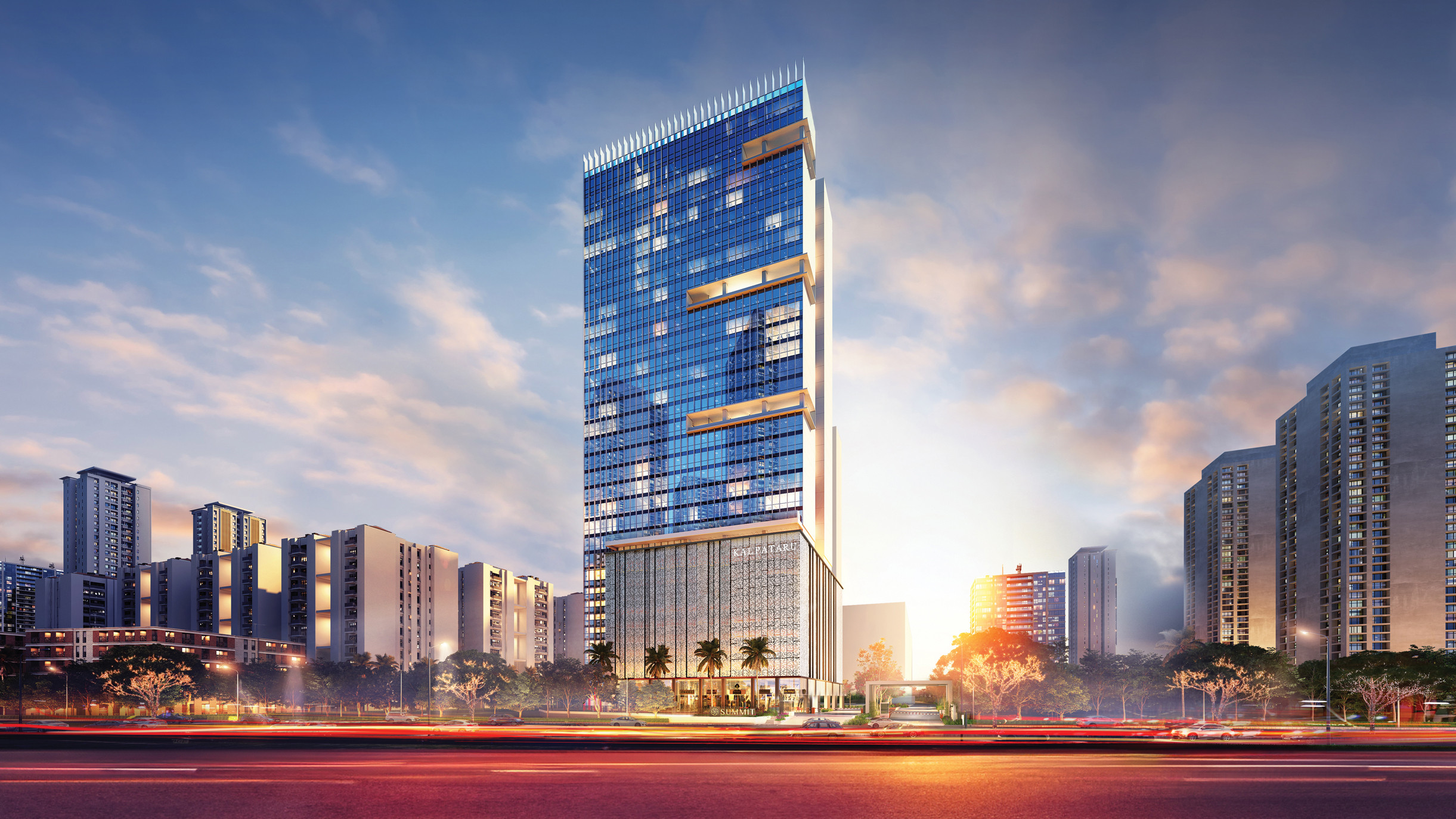
Consider Kalpataru Summit in Mulund (W), Mumbai, an accredited Grade A office development on LBS Marg with office spaces starting from 455 sq.ft.* onwards, expected to reach possession by December 2026. For those looking at the fast-growing central-suburban corridor, Kalpataru Virtus at Vikhroli (W) offers office and showroom spaces near the Gandhi Nagar Junction, with excellent road, rail, and metro connectivity, starting at ₹1.66 Cr* onwards and expected possession by December 2028. In Hyderabad, Kalpataru Avante brings Grade A office and showroom spaces to the Sanath Nagar micro-market, with possession also expected by December 2026.
Each of these developments was built to the standard the 2026 market now rewards.
*Prices mentioned are indicative and subject to change. Please contact our sales team for current pricing and offers. Possession dates are as per current construction schedule and may vary. Please refer to the RERA website for official project timelines.
India's commercial property market in 2026 rewards a clear goal. If you want stable, long-term rental income, Grade A offices with strong occupier demand deserve a close look. If liquidity and a small starting cheque matter more, listed REITs may suit you better, with SM REITs a step up at a ₹10 lakh minimum. And if you run a business, weigh ownership against leasing around your growth plans. Whichever path fits, the fundamentals point to a market with real depth, and a developer's track record is worth as much as the trend data when you choose where to commit.
Ready to explore commercial spaces built for 2026 and beyond? Explore Kalpataru's commercial projects across Mumbai and Hyderabad, or speak with our property consultants to find the right fit.
Frequently Asked Questions
What are the key commercial real estate trends in India for 2026?
The main trends are record office leasing led by Global Capability Centres, a shift to green Grade A buildings, mainstream flex space, growth in warehousing and data centres, and easier access through REITs.
What is driving commercial real estate growth in India?
Global Capability Centres are the main driver, expected to take 40 to 50% of 2026 office absorption, with IT, BFSI, flex, and e-commerce adding demand.
Is it a good time to buy commercial property in India?
Vacancies are tight near 14% and rentals are rising, which supports asset values. Returns are never guaranteed, so weigh your budget and consult a financial advisor first.
What is the difference between buying commercial property and investing in a REIT?
Direct ownership gives control and a tangible asset but needs large capital. A REIT lets you own a share of a managed portfolio from a small amount, easily traded.
Are Tier 2 and Tier 3 cities good for commercial property investment?
Increasingly, yes, especially in warehousing. Entry costs are lower, but check local connectivity and liquidity before you commit.
What is a Grade A commercial building?
It is the highest-quality category, with modern specifications, green design, and premium locations. In 2026 these command rental premiums and the strongest tenant demand.
Why choose Kalpataru for commercial property?
Kalpataru brings over 56 years of legacy and 125 delivered projects. Developments like Kalpataru Summit and Kalpataru Virtus offer Grade A specifications and strong connectivity.


